According to a new report from the Utah Division of Water Resources, state, regional, and municipal leaders should focus on reducing outdoor watering, not indoor water use—in order to boost inflows to Great Salt Lake.
For years, municipal and industrial (M&I) conservation tracked “use” at the pipe—how much water was diverted or delivered—even though some of that water might cycle through treatment and back into rivers, streams, and groundwater. The new Great Salt Lake Basin Integrated Plan report, “Municipal and Industrial Water Conservation Opportunities,” says cities should instead track “depletion”—water that doesn’t return to the hydrologic system.
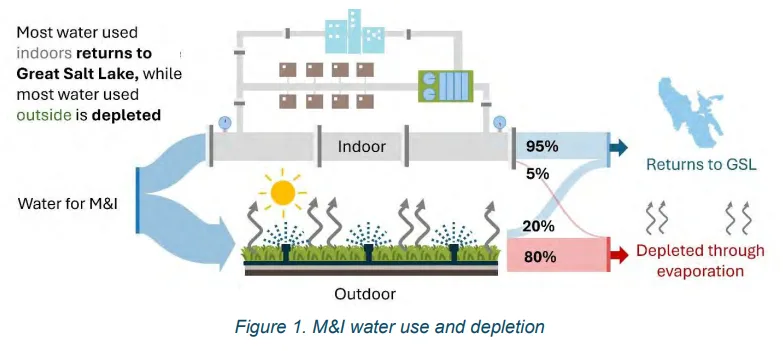
That’s because indoor water use, like showers or dishwashing, is mostly recycled, with only about 5% lost to depletion. Outdoor watering, by contrast, is far more wasteful: nearly 80% is evaporated and leaves the system.
The state’s analysis found that outdoor water use—primarly to water lawns—accounts for 96% of total M&I depletion.
Although agriculture still consumes the majority of water that would otherwise reach Great Salt Lake—about 64% of total diversions—cities and industries account for ~16%. Because municipal water use is concentrated in high-population areas with centralized infrastructure, cities are uniquely positioned to make a difference, the report says. With coordinated policies and widespread public outreach, urban areas can make substantial cuts to water depletion and help deliver water to the lake.

Policy Recommendations:
Cutting outdoor depletion is the fastest, most reliable way for cities to help restore Great Salt Lake. Utah DWRe recommends a mix of city-level and statewide actions:
Municipal initiatives:
- Expand turf conversion program: Replacing grass with waterwise landscapes could reduce depletion by an estimated 183,000-219,000 acre-feet.
- Promote smart irrigation controllers: Weather-based systems that adjust watering schedules automatically could save an estimated 42,000-135,000 acre-feet.
- Increase on-site irrigation audits: Detecting inefficiencies and leaks could reduce depletion by an estimated 31,000-106,000 acre-feet.
- Adopt stronger tiered water rates, paired with secondary metering: More aggressive allotment-based pricing structures could cut an estimated 10,000-72,000 acre-feet.

State and regional initiatives:
- Updating development codes: Ban nonfunctional turfgrass in new construction. A similar proposal (H.B. 328, 2025), sponsored by Rep. Doug Owens (D), was introduced but failed to pass out of the House.
- Set regional budgets for water supply and depletion: These budgets could hold water users accountable without making changes to water rights or existing policies.
- Dedicate conserved water immediately: Because large-scale reductions in depletion will take time, the report advises immediately dedicating conserved water—such as indoor water that cycles back into the system—directly to Great Salt Lake, rather than allowing it to be intercepted for other uses.

Individual choices matter, too. Here are steps you can take right now:
- Replace grass lawns with water-wise landscaping (rebates are available through state and local programs to offset the cost)
- Reduce outdoor watering
- Install high-efficiency appliances (rebates are available to make the switch more affordable)
- Support water conservation policies in your city
- Contact your elected officials and speak up for the lake